

From Funnel to Flow: Rethinking E-Com Around Conversations
Ditch the static funnel—modern e-commerce thrives on conversational flows that mirror how people actually shop today.
DATE
CATEGORY
HASHTAGS
READING TIME
The traditional e-commerce funnel is failing modern buyers. Today’s shoppers expect fast, personal, and flexible communication—just like they get in their favorite messaging apps. As digital behaviors shift, brands must evolve from static, one-size-fits-all funnels into dynamic, two-way flows. These flows empower customers to engage at their own pace, ask questions, compare products, and even complete purchases—all within a single conversation thread. In this post, we explore why it’s time to rethink the funnel and how conversational commerce is setting a new standard for customer engagement.
From Funnel to Flow: Rethinking E-Com Around Conversations
“Customers don’t think in funnels. They think in questions, needs, and moments.”
The Funnel is Dead (or at least outdated)
Once the gold standard, the sales funnel assumed a linear, step-by-step path: awareness, interest, decision, action. But real-life shopping isn’t like that anymore. Modern consumer behavior is nonlinear, fragmented, and hyper-personal. People bounce between devices, check products late at night, and expect brands to respond instantly.
Relying on forms, email sequences, and drip campaigns to nudge people down a path no longer works. It frustrates users, increases drop-off rates, and causes operational strain as support teams scramble to keep up.
Enter the Conversational Flow
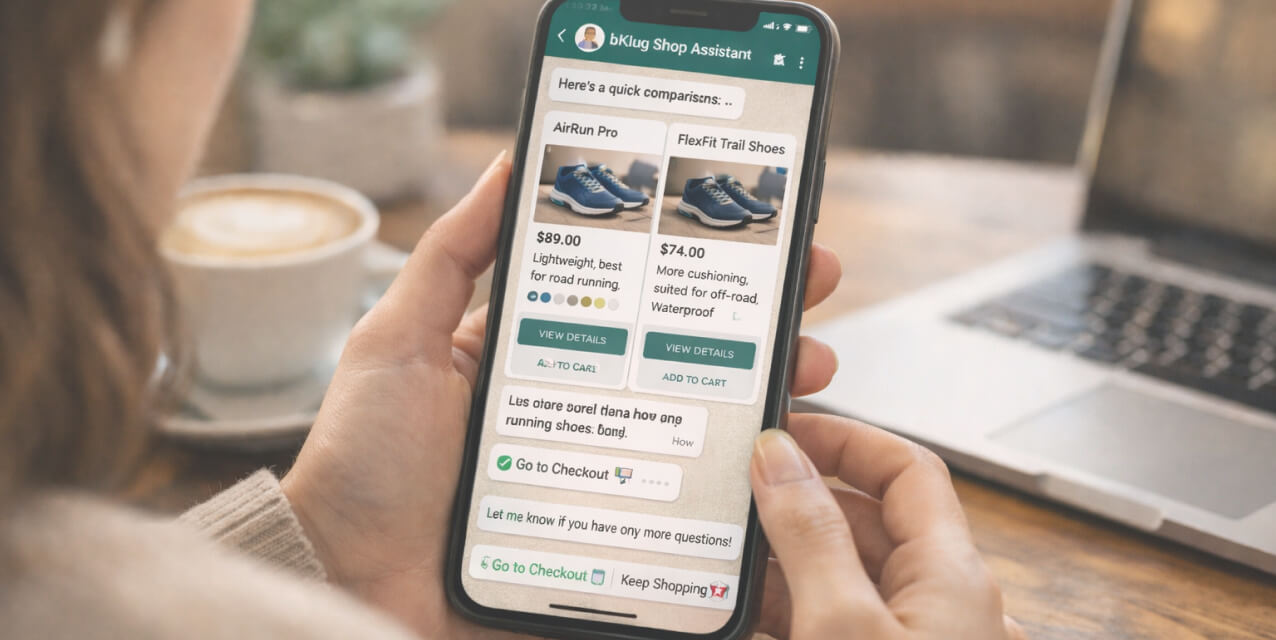
Conversational flows shift the model from rigid sequences to fluid, responsive interactions. Think of it like a conversation with a skilled salesperson who listens, answers questions, and helps you buy—only it’s AI-powered and available 24/7 on platforms people already use, like WhatsApp.
With AI assistants like bKlug, these flows are now scalable, secure, and hyper-personalized. The entire shopping journey—product discovery, filtering, comparison, cart, and checkout—can unfold inside a single thread, adapting in real time to each user’s behavior.
Why Funnels Fail Today
- They’re slow: Waiting for email replies or form follow-ups kills momentum.
- They’re generic: Static content doesn’t reflect individual preferences or timing.
- They’re leaky: Users drop out at each step, especially on mobile.
Conversational flows solve these problems by letting shoppers drive the journey. They can jump in and out at any point, resume conversations days later, and get consistent, context-aware responses.
A New Playbook for Modern Brands
Smart brands are adopting flows that prioritize speed, context, and personalization. Here’s what that looks like in practice:
- Instant answers: AI assistants reply to product questions in seconds.
- Context carry-over: Conversations pick up where users left off—whether 8am or 9pm.
- Multi-product journeys: Compare, filter, and explore SKUs within chat.
- Integrated checkout: No redirects—customers pay directly from the conversation.
How bKlug Powers Flows at Scale
bKlug is purpose-built for this new flow-based commerce. It provides an AI-powered WhatsApp assistant that guides shoppers from hello to checkout without the friction of traditional systems.
Key features include:
- Real-time product discovery and filtering
- Personalized recommendations
- Visual search
- Cart management inside chat
- Checkout via payment links
- Multilingual and voice support
- Franchise and multi-store integration
- Banking-grade safety, privacy, and moderation
“It’s not about replacing humans—it’s about removing friction, scaling quality, and being there when your customer is ready.”
Flows Reduce Operational Load, Not Just Boost Sales
Conversational flows don’t just convert better—they simplify operations across the board:
- Tech burden: No need to build or manage AI systems internally.
- Marketing overhead: No manual flow creation or update needed—AI adapts automatically.
- Support scaling: Reduce reliance on large teams; AI handles spikes without sacrificing quality .
That’s the beauty of systems like bKlug: once set up (often in under 2 hours), they run with minimal input, freeing teams to focus on strategy, not busywork.
Measuring Success in a Flow-Based Model
With flows, KPIs shift:
- Response time becomes crucial
- Conversation completion rate replaces form fill rate
- Repeat interaction becomes more valuable than raw traffic
In short, you track how engaged and satisfied the customer is—not just how far they made it down a funnel.
What This Means for E-Com Teams
For marketing, this means rethinking campaigns around moments, not sequences. For sales, it means enabling continuous, on-demand conversations. For CX, it means offering proactive, human-like assistance without ballooning your headcount.
And for leadership? It means embracing infrastructure that grows with customer expectations—not in spite of them.
Final Thought: From Push to Pull
The future of commerce isn’t about pushing people through pre-defined paths. It’s about pulling them into meaningful, timely, and helpful conversations.
That’s what bKlug is built for. It’s not just another chatbot. It’s a shift in how brands engage, sell, and support—one conversation at a time.