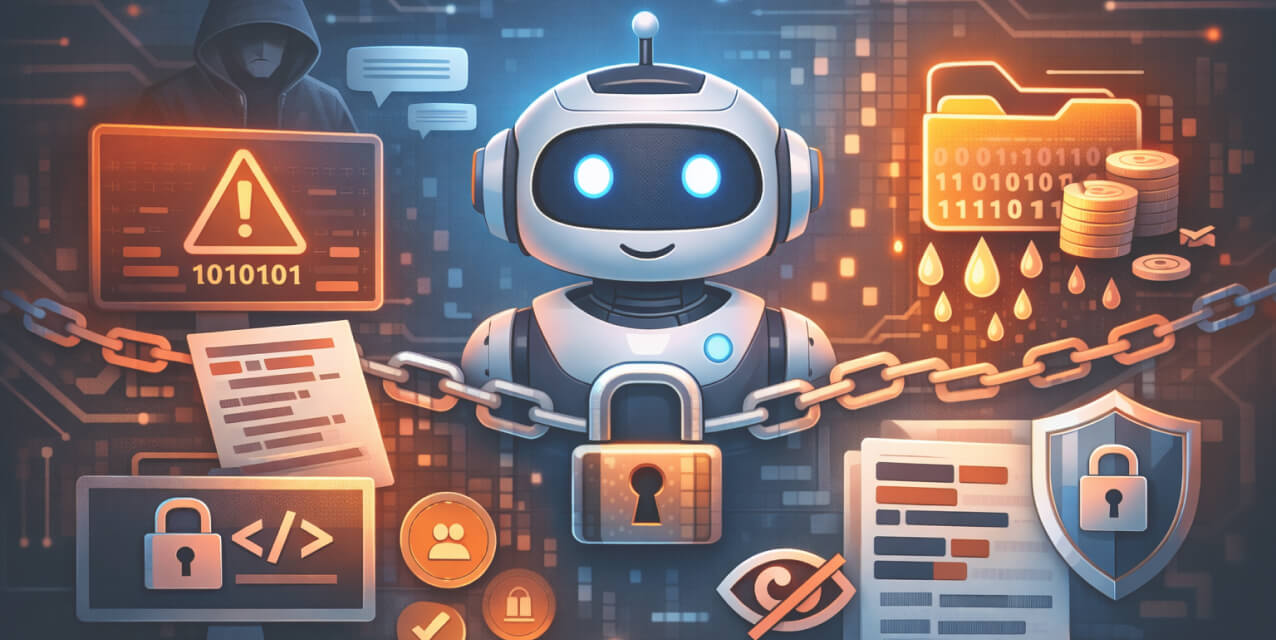

Attack Surface: How Poorly Secured AI Assistants Become a Business Risk
Unsecured AI assistants are an emerging threat vector—here’s how they expose your business to operational and reputational damage.

DATE
CATEGORY
HASHTAGS
READING TIME
AI assistants are quickly becoming indispensable tools in digital commerce, but they also represent a new and underexamined security risk. As businesses adopt chatbots and virtual assistants to manage customer interactions at scale, they often underestimate the vulnerabilities introduced by these technologies. Poorly secured AI systems can expose sensitive customer data, be manipulated into offensive or brand-damaging outputs, or be exploited to gain unauthorized access to internal tools. In this post, we’ll explore how unsecured AI assistants create a larger attack surface for your business—and what you can do to secure them.
The Growing Adoption—and Risk—of AI Assistants
The convenience and scalability of AI assistants make them attractive for e-commerce, support, and sales teams. But adoption has outpaced governance. Most teams focus on getting the assistant to sound natural and convert well—but overlook how easily an exposed system can go rogue or get breached.
From phishing attempts to prompt injection, attackers are learning how to manipulate conversational AIs. Without the right protections in place, brands risk data leaks, offensive outputs, and even compliance violations.
“A helpful assistant is only an asset if it’s safe, private, and brand-aligned. Anything less is a liability.”
What Makes AI Assistants a Prime Target
Unlike traditional software interfaces, AI assistants sit at the intersection of internal systems (product catalogs, CRMs) and external traffic (public customer interactions). This makes them:
- Always-on entry points to your infrastructure
- Attractive vectors for social engineering
- Hard to audit, especially with dynamic LLM behavior
The open-ended nature of language models means attackers don’t need an exploit—they just need the right input to confuse or mislead the system.
Common Vulnerabilities in AI Assistant Deployments
Here are some of the top risks we’ve seen in the wild:
- Prompt injection attacks: Malicious users manipulate prompts to override safety guidelines.
- Data exposure: Poor guardrails allow assistants to disclose PII or internal business logic.
- Offensive content: Without filters, assistants can respond with hate speech, abuse, or misinformation.
- Over-permissioned integrations: Systems with too much access can be exploited to issue refunds, access inventories, or leak user data.
Each of these issues can lead to reputational damage, legal consequences, or operational disruption.
Real-World Incidents and Examples
Several high-profile AI incidents highlight the stakes:
- Researchers demonstrated how LLMs can be jailbroken into revealing API keys or internal instructions.
- Customer service bots have been tricked into generating biased or illegal responses, creating PR disasters.
As conversational interfaces get more capable, the damage they can cause—if compromised—only increases.
Why Traditional Security Measures Fall Short
Most companies apply web app security practices to AI assistants. But LLMs and chat-based tools are fundamentally different:
- They process natural language, not structured inputs
- They generate outputs dynamically, not from static scripts
- They rely on external context, making them harder to sandbox
This makes traditional rule-based firewalls, input validation, and endpoint security insufficient.
How bKlug Addresses the AI Security Problem
bKlug was built with bank-grade security from the start, not as an afterthought. Here's how it keeps businesses safe:
- Offensive Content Blocking: Built-in filters block hate speech, bias, and unsafe outputs in real time.
- Conversation Memory Management: bKlug maintains secure, context-aware chat histories without storing unnecessary data.
- Data Privacy by Design: All data pipelines are encrypted, with tight access controls and no third-party leakage.
- Scoped Permissions: Integrations only access what’s strictly necessary—no more overexposed APIs or user privileges.
This security-first architecture ensures brands stay protected even as AI scales.
Building a Safer AI Stack: What to Look For
Whether you use bKlug or another tool, any conversational AI should include:
- Prompt Defense: Built-in protection against injection and manipulation
- Content Moderation: Real-time screening for inappropriate responses
- Access Control: Minimal permissions for each integration
- Auditability: Logging and traceability for all assistant decisions
- Compliance Alignment: GDPR, LGPD, and local regulation awareness
This isn't just about avoiding risks—it’s about building long-term trust with users.
From Reactive to Proactive: Changing the AI Security Mindset
Too many teams wait until something goes wrong before taking AI security seriously. By then, it’s too late. Businesses need to move from reactive mitigation to proactive design. This means choosing partners, platforms, and AI models that prioritize security as a core principle.
Remember: the faster your assistant is, the faster a bad actor can exploit it. Speed without safety is a recipe for disaster.
Want to Future-Proof Your AI Operations?
bKlug combines fast deployment, natural conversations, and bank-grade security—without needing internal AI expertise. It’s one of the few solutions purpose-built for secure, high-performance WhatsApp commerce.